Your sync tools are working perfectly. So why did the wrong audio reach 2 million viewers?
What’s the Difference Between AV Sync and Content Integrity Monitoring?
AV sync verification and content integrity monitoring are both essential. But they solve different problems, and confusing one for the other can contribute to broadcast incidents.
How AV Sync Works, and What It Can’t See
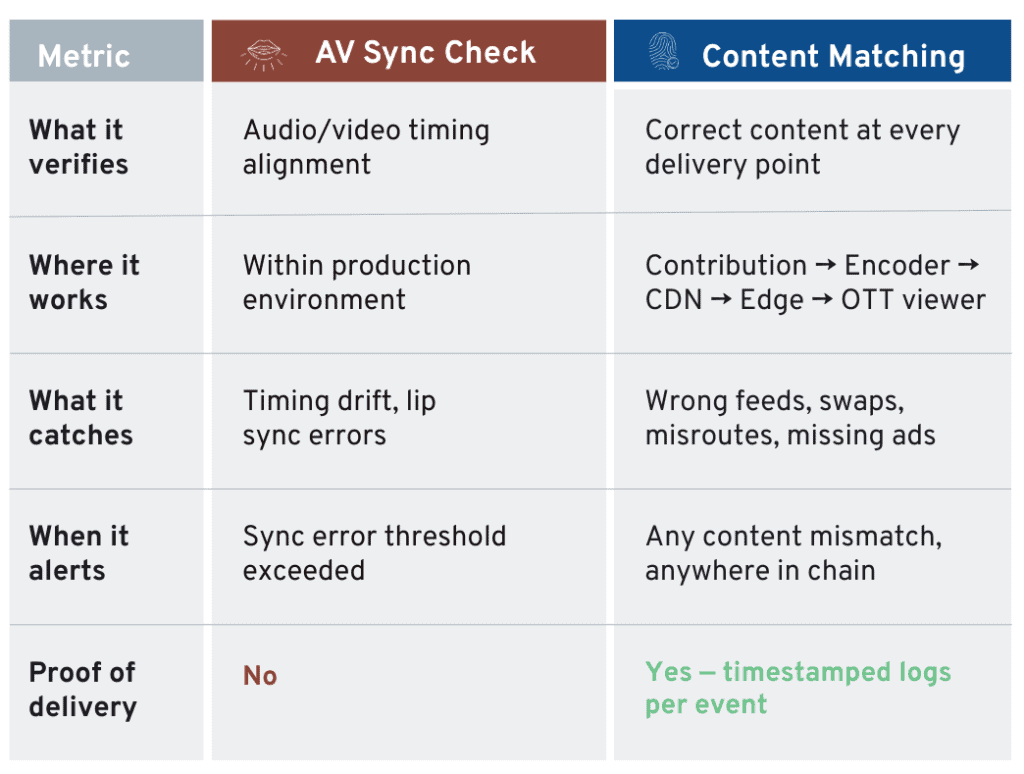
AV Sync checks whether the audio and video tracks in a stream are temporally aligned. It measures the timing relationship between what you’re seeing and what you’re hearing, and flags when that relationship drifts beyond an acceptable threshold. It’s a single-point check, performed at the monitoring location where the tool is deployed. It tells you: are these two tracks in time with each other?
It does not tell you whether those tracks contain the right content.
Content Matching works differently. It creates a unique fingerprint for every video and audio frame in a stream, a lightweight representation of what that content actually is, independent of resolution, bitrate, or format. That fingerprint is then compared against the same content at other points in the delivery chain: contribution feed, encoder output, packager, CDN edge, OTT endpoint.
If the fingerprints match, the right content arrived. If they don’t, the system flags it in real time, with the exact location in the chain where the mismatch occurred.
The key difference: AV Sync operates at one point in time, on one stream. Content Matching operates across the entire chain, on every stream simultaneously, continuously.
AV Sync vs. Content Matching: What Each Tool Monitors
Where AV Sync Stops and Content Integrity Monitoring Begins
The incidents that cost broadcasters the most, wrong audio on a regional feed, a misrouted channel, an ad segment that never played, all happen downstream of the production environment.
Sync tools can’t see there. They’re watching the production layer. By the time content reaches your CDN, edge nodes, and OTT endpoints, those tools have already handed off.
That handoff point is where content integrity monitoring begins, and where most operations are currently operating without the right data.
How Content Matching Monitors the Full Delivery Chain
Content Matching uses fingerprinting to tie a specific piece of content to every point it touches in the delivery chain.
It knows what left the encoder. It knows what arrived at the CDN. It knows what reached the edge. It knows what the viewer received.
If any of those don’t match, wrong version, wrong language track, missing segment, swapped feed, the system flags it in real time, with a timestamp and chain location attached.
- No manual spot checking
- No waiting for viewer complaints
- No gap between “it left us fine” and “it reached them wrong”
Broadcast Incidents That AV Sync Tools Won’t Detect
- Wrong regional audio track on a live sports feed, syndicated to 12 markets, one market receives the wrong language version. Sync is perfect. Content is wrong.
- Feed swap during live coverage. The right signal is present, audio and video are in sync, but the source feed was switched and no one caught it before the stream went live.
- Ad segment that never played. The insertion point triggered, the CDN reported delivery, but the actual content fingerprint never matched. The makegood happens before you even knew there was a failure.
- Missing content on OTT. A packaging step dropped a segment. Signal is present at the edge. Sync is fine. Three minutes of a live event are missing for subscribers on one ABR profile.
The bottom line: sync verification is necessary. It’s not sufficient. For operations running live events, FAST channels, multi-region distribution, or ad-supported tiers, content integrity monitoring is the safety net that catches what sync tools cannot see.
The incidents that cost broadcasters money, fines, makegoods, subscriber churn, wrong content on air, live downstream of the production layer. That’s where Content Matching works.