Enabling Low-Latency, Software-Based Monitoring with Matrox ConvertIP
Broadcast and media operations are undergoing a decisive shift from hardware-centric workflows to agile, software-defined architectures. TAG Video Systems has been at the forefront of this transition, pioneering an all-IP, software-only platform for monitoring, visualization, and quality assurance. Initially proven in Master Control Room (MCR) deployments, TAG’s platform is now expanding into Production Control Room (PCR) environments where low latency and real-time responsiveness are critical.
A key enabler of this expansion is the integration with Matrox ConvertIP. By providing ultra-low-latency ST 2110 to HDMI conversion, ConvertIP unlocks seamless monitoring for production teams who require precision timing and uncompromised visual fidelity. Together, TAG and Matrox are demonstrating that software-first IP workflows can meet the exacting demands of live production.
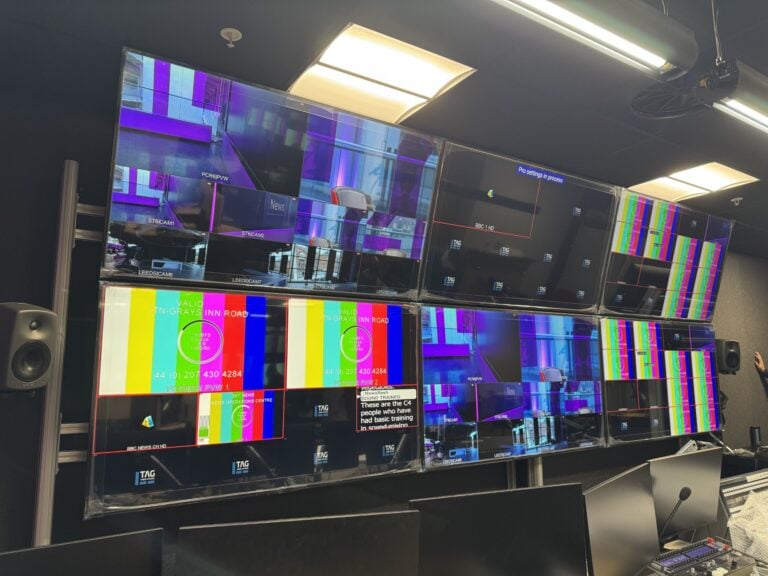
TAG's IP-Only Architecture
TAG Video Systems is a global leader in software-based IP monitoring and multiviewer solutions. Their platform is designed around the principle of pure software deployment, requiring only CPU-based processing—eliminating the need for specialized GPU hardware. This approach delivers maximum deployment flexibility across on-premises servers, virtualized data centers, and public cloud environments.
By leveraging dual NICs and advanced CPU threading, the platform optimizes load balancing to handle the high bandwidth requirements of modern live video workflows. This architecture enables TAG to deliver consistent performance across a wide range of use cases, from live production monitoring and signal processing to playout and OTT distribution.
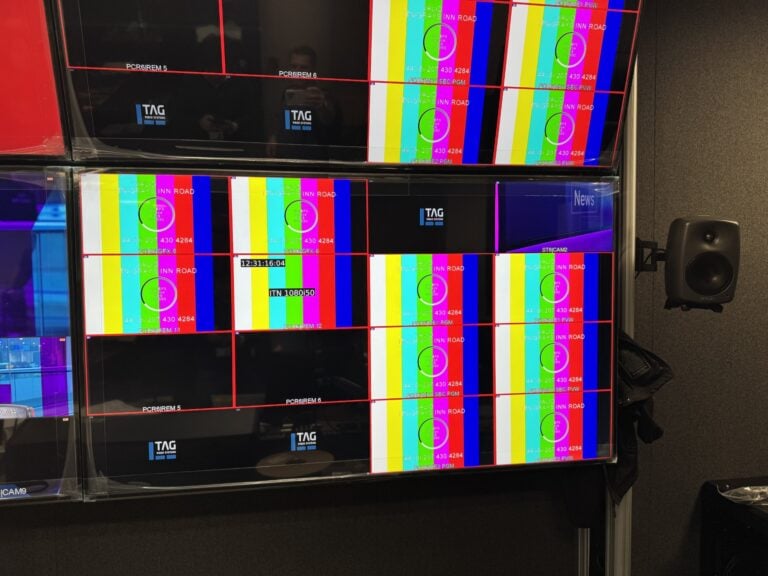
System Integration & Signal I/O
TAG’s software platform supports a comprehensive range of input formats, including uncompressed ST 2110, mezzanine codecs such as JPEG XS, and compressed transport streams like HLS, SRT, and Zixi. On the output side, operators can select from equally diverse options: uncompressed ST 2110, low-latency WebRTC, NDI, HLS, or HDMI monitoring via Matrox ConvertIP.
A distinguishing feature of TAG’s solution is its ability to generate flexible multiviewer mosaics and perform on-the-fly transcoding. All signal paths remain within the IP domain, ensuring that return feeds and remote contributions can be accessed seamlessly, regardless of location. This IP-first approach futureproofs workflows while eliminating the inefficiencies of legacy SDI infrastructure.
Matrox ConvertIP: Enabling PCR Workflows
As production workflows migrate to IP, bridging the gap between IP-based transport and operator-facing displays becomes essential. Matrox ConvertIP addresses this need by delivering ST 2110 to HDMI conversion with ultra-low latency. This makes it an ideal companion for PCR operations, where real-time visualization directly impacts editorial and production decisions.
ConvertIP also incorporates HDR support via ST 352 packet flag handling, ensuring that the full fidelity of HDR signals is preserved in the monitoring chain. Additionally, support for JPEG XS enables flexible distribution over bandwidth-constrained wide area networks, extending PCR-grade monitoring capabilities into remote and hybrid environments.
Performance Validation
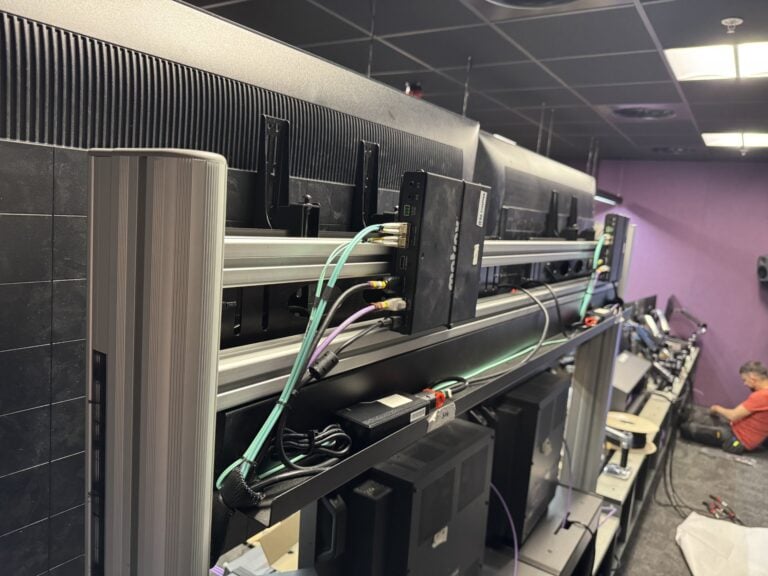
The effectiveness of the TAG–Matrox integration has been validated in real-world deployments. In a competitive head-to-head evaluation at a major UK-based media production and broadcast journalism company, the combined solution outperformed a traditional FPGA-based multiview system. The production company reported that TAG’s software-only rendering combined with Matrox ConvertIP output achieved end-to-end latency of just 1–1.5 frames—well below the threshold required for PCR operations.
This decisive performance advantage led the production company to select and deploy the TAG–Matrox solution in its Production Control Room, confirming that software-defined IP workflows are not only viable but superior for mission-critical live broadcast applications.
Market Opportunity
The migration from MCR to PCR represents a major inflection point for broadcasters and live content producers. While MCR workflows emphasize scale and reliability, PCR environments demand responsiveness, accuracy, and low-latency interaction. TAG’s platform, when combined with Matrox ConvertIP, delivers on all these fronts.
Applications extend beyond fixed facilities into outside broadcast trucks, live sports coverage, and hybrid or cloud-based productions. By enabling seamless visualization from IP streams to local operator displays, Matrox ConvertIP completes the IP workflow loop, providing the confidence operators require when making real-time production decisions.
Roadmap & Future Developments
Looking ahead, TAG and Matrox are committed to advancing the state of software-based, standards-driven broadcast technology. Upcoming developments include deeper integration of JPEG XS to support WAN and cloud workflows, and expanded HDR capabilities to ensure compatibility with next-generation production formats.
The partnership will also be showcased at industry events such as IBC, SVG, and the Digital Sports Summit, where TAG and Matrox will highlight their joint contributions to live production innovation.
Conclusion
Together, TAG Video Systems and Matrox ConvertIP are redefining what’s possible in broadcast infrastructure. By proving that a software-defined, standards-based IP platform can meet the stringent demands of PCR and live production, the partnership empowers media organizations to scale, innovate, and operate with confidence in a rapidly evolving industry. Software-only IP workflows, once confined to MCR, are now enabling the agility, speed, and reliability required for PCR. With TAG’s software platform and Matrox ConvertIP bridging the gap to real-time visualization, broadcasters can embrace the future of live production without compromise.