For years now I have the same conversation on show floors. Somebody stops at the stand, looks at the wall of sources, and files us under one word: multiviewer. It is fair. We build a good multiviewer, and I am glad to be judged on it. It is also one part of a larger job, and the larger job is the reason we exist.
Where a multiviewer shines: live production and live sports
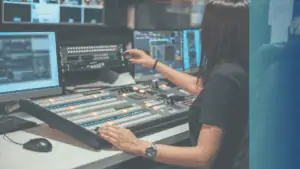
Let’s start with what the wall is genuinely good for. In live production, and above all in live sports, an operator needs to see many sources at once and react in the moment. A match does not wait. When a feed drops in the second half, somebody has to catch it on the wall and switch, right then, with no time to read a report. That is the multiviewer doing exactly what it is built for, and nothing replaces it.
If you run galleries and big live events, you want a serious one, with real resolution and low latency, and the professional feature set that took years to build. We are proud of ours. So this is not an argument against the wall.
Where the multiviewer runs out: at scale
The wall works because a person is watching it. That is also its limit. One operator can hold maybe a few dozen sources in his attention. Ask them to watch a thousand channels across three sites and two countries and the model breaks, because nobody can stare at a thousand pictures and catch the one that just lost its audio.
That is where most broadcasters sit today. They monitor some stages, not the full chain, and even the stages they cover are covered thinly. The wall shows the handful of points somebody chose to put on it. Everything between those points is a guess, and at scale the guesses are where the failures live.
Monitoring vs multiviewing: which one is the system?
This is the part I keep insisting on, and I will keep insisting on it. We are a monitoring system. Multiviewing is one of the things a good monitoring system should be capable of. That order matters.
The story some vendors tell runs the other way around. They start as a multiviewer, add a few monitoring features, put some big wheels and a bigger engine on the thing, and call it modern. That is a bad story. You end up with a nicely tuned multiviewer that still only sees the points on the wall.
Build monitoring first and multiviewing comes along for free, because a wall of sources is a small part of watching a whole chain. Build the multiviewer first and monitoring is always the thing you bolt on afterwards.
Finding faults faster is the real job of monitoring
Strip away the technology talk and the customer’s actual pain is simple. Something goes wrong in the chain, and it takes too long to find out where and why. They cannot see the whole path, so when a fault appears they are hunting for it while the clock runs.
The job of monitoring is to shorten that hunt. Watch the complete production chain carefully, so that when a problem shows up you can identify it and clear it quickly. Deliver what you meant to deliver, catch the failures early, and eliminate them faster than you do today. That is the outcome the engineer at the stand is really asking about, even when the question comes out as “how many inputs.”
For a long time this conversation was buried under infrastructure. Everyone talked about SMPTE ST 2110, about networks, about how the signal gets from one place to another. That is logistics. It matters, but it says nothing about what was carried on the wire, or whether it arrived intact. Content is the thing the viewer pays for. Monitoring is how you protect it.
How to protect the whole broadcast chain at scale
So it is not a choice between the wall and everything else. You keep the wall for the moments that need a human eye, live production and live sports and the events where seconds count. And underneath it you need the parts a wall cannot do.
You need to watch the whole chain, from capture to the viewer’s device, and not only the points someone chose to put on the wall. You need the system to raise its hand when something drifts, because once the channel count runs past what any person can watch, waiting for someone to notice is not a plan.
Monitoring has the most value when it covers the entire workflow, end to end. The multiviewer is one facet of that, and an important one. At the scale most of you now operate, the rest is what keeps you on air.

Oliver Gappa |Sales Director, EMEA| TAG Video Systems
Oliver Gappa is TAG’s EMEA Sales Director. A passionate sales leader with 20+ years in Broadcast, Media, and Telco, Oliver has helped companies grow across EMEA and beyond. He thrives on building trusted relationships, scaling new markets, and driving digital transformation with software and SaaS solutions.